How many clusters? Scans
Most clusterings are given their number of clusters, and the number is the choice that matters most. A scan answers it by clustering the same frames many times:
at every k (the elbow);
at every radius (eQual);
over algorithms, metrics and seedings (the sweep).
Three views beside the scores help where the scores alone do not decide: the stability of the clusters across seedings, HELM’s merges’ heights, and eQual’s radius.
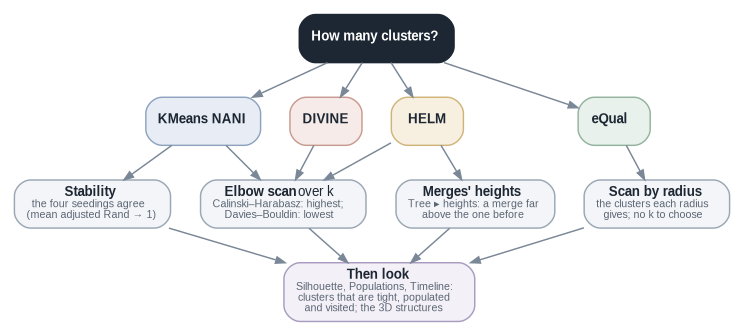
A complete analysis reads all of them on one trajectory.
A scan clusters the same frames many times, and keeps every clustering:
its scores and its clusters’ sizes, in the table and the plots;
its labels, to make it the clustering later (measured then).
The coordinates are read once for the whole scan. HELM’s scores with a trim read them twice more, every k’s together. The library is given one list of them for every clustering, made once.
A value that its parameters cannot take is kept as not run, with the reason, and the scan goes on. Such values are:
NANI’s seeds at a larger k;
HELM’s starting clusters, counted after its first clustering, and its trim (
-trim-val’s, once HELM has run);with the library, DIVINE seeded by CompSim below 50% above k 2, which would take VMD with it.
A scan where none can run is refused, and the one there was is kept.
A clustering that fails is kept as failed, with the backend’s message (a
crash of mdance-cli too). mdance-cli ended from outside (Ctrl+C at
VMD’s terminal, kill) stops the scan, as Cancel does. The scan that
was there is kept.
In the window, an elbow scan cancelled after two values or more keeps them as the scan, and the line at the bottom says which. HELM’s does not: its values are scored together once all are made.
Elbow
The Setup’s algorithm and parameters at every k of a range.
From the command, a scan takes its own options, as a clustering does. One
not given is the command’s default (Cα, KMeans NANI seeded StratAll),
not the current run’s. So
vmdance elbow -sel $sel -kinit CompSim -from 2 -to 15 -by 1 (or
-ks {…}) follows a clustering of $sel seeded by CompSim. The scan
says what it reads, and notes when that is not what the current run
clustered.
HELM starts from the same clusters at every k: its first NANI clustering is made once. A record’s number of clusters counts those with frames.
In the window’s Scans box, the k row is shown for the algorithms that take a k, and the radius row for eQual. Stability is KMeans NANI’s only.
The Elbow plot shows the two scores. A peak of Calinski–Harabasz, or a low
point of Davies–Bouldin, suggests a k. Hover a k for its clusters’ shares.
A k at which one cluster takes nearly everything, or several hold a few
frames, is seldom the one. vmdance elbow load 6 (or a double-click)
makes that k the clustering.
What the scan points to. The Elbow plot rings the values the scores
point to. A line of words above it, the Scans box and
vmdance elbow suggest say them:
Davies–Bouldin’s lowest value, and its sharpest dip: the local minimum that bends most. There the second difference is largest: the score before plus the score after, less twice its own. These are MDANCE’s two criteria: the lowest DB, and the maximum second derivative of DB.
Calinski–Harabasz’s highest value.
The values the seedings agree on: a stability of 0.9 or more, when the scan measured it.
elbow suggest returns them, and the sentence (words). They are
db_lowest db_second db_dip db_dip2 ch_highest ch_peak stable
most_stable
. Each is a k, or a radius of an eQual scan, and empty where
the scan does not say.
The readings need not agree, and the plugin does not choose. On MDANCE’s tau peptide, Davies–Bouldin is lowest at k 2 and dips most at k 6, and the seedings agree only at k 2 and 3 (A complete analysis says what each means).
A third curve, Scores ▸ Variance explained in the Elbow plot, is the share of the frames’ variance that the clusters explain. It comes from the Calinski–Harabasz score: SSR/SST = CH (k − 1) / (n − k + CH (k − 1)). It rises with k. Where it bends, another cluster stops adding much. This is the curve with an elbow, and cpptraj’s SSR/SST.
The two scores seldom settle the choice of k. On structures that are not in well-separated states, Davies–Bouldin falls as k grows, to the end of the range, and Calinski–Harabasz favours the smallest k. Three more views:
Stability (
vmdance elbow … -stability 1; k-means NANI). Every k is clustered again from the four seedings that draw no random number (StratAll, StratReduced, CompSim, DivSelect). The stability is the mean adjusted Rand index of every two (1: the same clusters whatever the seeding).A k whose clusters do not depend on the seeding describes the frames, not the seeds. A scan that is never stable (below about 0.5 at every k) says that the frames hold no clusters k-means finds at those k. A stable k is reproducible; that alone does not make it the right one.
The scan takes four times as long. The Elbow plot draws the stability as bars in a strip under the scores, on a scale from 0 to 1. The scan’s records and its export have it as a column.
The merges’ heights. HELM merges its starting clusters two by two. The MSD within the cluster each merge makes is its height (the Tree plot’s merges’ heights). For the other algorithms, it is the average linkage of their clusters. The number of clusters before a jump in height is a k to try (
vmdance treegives them:heights).The plot circles a jump only when it stands out: twice the merge before, and half as much again as the next largest jump, among the coarser half of the merges. It says so when none does (The plots).
eQual’s radius. eQual is given no k but a radius, and finds as many clusters as that radius makes.
vmdance elbow -algorithm equal -radii {0.5 1 2 4}(or the Scans tab’s range of radii) scans it. The number of clusters each radius gives stands beside the scores, in the strip under them. A plateau over several radii is a k the frames hold.The radius is MDANCE’s MSD (Ų), half the RMSD² of a frame and its seed. A frame joins a cluster within √(2 × radius) Å of RMSD, which Setup writes under the field.
Which radii to try depends on the frames. Suggest (in the Scans box; Suggest a radius in Setup;
vmdance radii) measures the distances between about 150 frames, evenly taken. It proposes a range in ten values (nine steps): from the distance the nearest 2% of their pairs are within, to the one half of them are. Setup’s Radius, when empty or at its default (2), gets the distance a tenth of the pairs are within. A radius you typed is kept.
Sweep
Every combination of algorithms (KMeans NANI, DIVINE, HELM), metrics,
seedings and values of k, in that order (k changes fastest). For example:
vmdance sweep -algorithms {kmeans helm} -from 2 -to 10 -metrics MSD
-seedings {StratAll CompSim}
.
DIVINE with a metric other than MSD is kept as not run: it splits by MSD.
Neither scan takes DIVINE’s
-end-mode points, which does not use k.The other parameters are the Setup’s. In a script they are given as
-params {kmeans {percentage 20}}, where a seeding is refused: it is-seedings.The input is the options given, as the elbow’s.
HELM’s seeding is its first clustering’s. HELM from a label file (no first clustering) and DIVINE with pair anchors (no NANI) use none. They are run once at each k, their seeding none.
The table marks the best Calinski–Harabasz (green) and the best
Davies–Bouldin (blue). A failed configuration is never best, nor is one
without scores (one cluster, or every cluster a frame alone). Of equal
scores, the first wins. vmdance sweep best db names it.
sweep load n (or a double-click) makes a configuration the
clustering.
In the window, more than 50 configurations are confirmed first. Cancel stops the sweep between clusterings or during one. With the library, VMD waits for each, and Cancel acts when it ends.