Design
VMDance replaces the MDANCE VMD plugin that its repository held before. It was rewritten from scratch. It follows the principles of the authors’ DihedralView, InteractionView and Molywood Studio plugins.
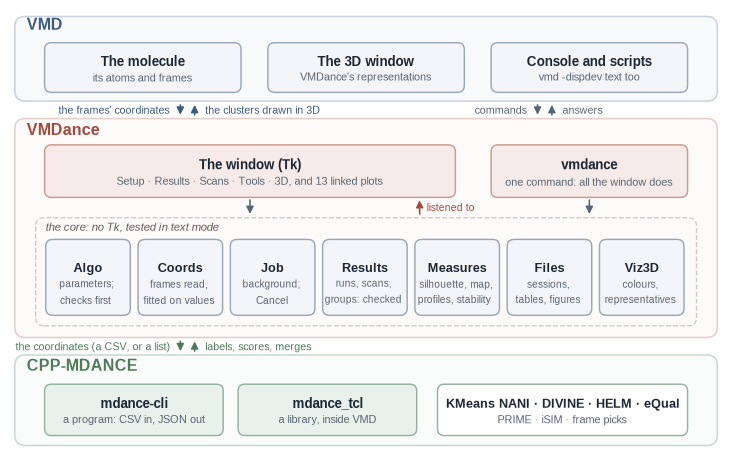
The parts: VMD’s molecule and 3D window; the window and the command over one core; CPP-MDANCE, as a program or as a library inside VMD.

One clustering’s way. Everything that can be checked is checked before the backend runs. The answer is checked whole before it is shown.
Principles
One package, one command.
vmdanceopens the window, and its options and subcommands do everything the window does. A new window feature gets a subcommand (_api_*invmdance.tcl) and a test.The core without Tk.
json,molecule,algorithms,backend,coords,measures,analysis,results,session,exportandviz3dnever use Tk. The window’s modules are loaded only when it opens (_load_tk). The 3D drawing is core: the command draws in 3D too. The core is tested invmd -dispdev text, and the parts that need no molecule in plaintclshtoo.One job at a time, published whole. A clustering is one value (a dict), checked and published at once (
Results::publish). A failed, cancelled or refused job leaves the current one untouched. The runs, the scans, the picks and the selection live in the core too. The window listens to them (Results::listen) and holds no results.One table of parameters. The command’s options, the window’s fields, the checks, the backend’s arguments and the parameters page are made from one table (
Algo::A), withmdance-cli’s names.Never trust what is read.
The backend’s JSON is read by a reader of the plugin’s own, and checked whole before anything is published.
Sessions, the MDANCE plugin’s sessions, label files and preferences are parsed as data, never evaluated.
Numbers are checked before
exprsees them. It would compare1oas a string, read010as octal, rewrite1e10as a float, and fail onNaN.Strings a user typed or a file holds are returned with
_getorif, never throughexpr’s?:.A session is someone else’s file. Its lists are counted before they are made (a few kilobytes can otherwise allocate gigabytes), and bounded. The files its molecule record names are refused unless they are regular files of one of VMD’s own readers. So loading one never runs a converter, downloads a file, reaches a shell, or blocks on a device.
VMD state is borrowed, not taken.
A job never moves VMD’s frame or coordinates.
Every atom selection is made and deleted at the global level, also on errors and on Cancel. VMD deletes a selection when the procedure that made it returns, and refuses a delete from elsewhere.
The plugin draws with representations of its own, and deletes only those.
It writes the molecule’s data only when asked.
It changes the frames of no molecule but one a session loaded itself: its PDB’s own frame deleted again, as it was when it was clustered.
Responsive. A job runs in a coroutine. The frames are read in slices of 40 ms,
mdance-cliruns in the background, and the plots’ frame markers are refreshed at most every 120 ms.
Choices of this plugin
The backend’s science, as the reference. The clusterings are CPP-MDANCE’s. The tests:
run
mdance-clidirectly on the coordinates the plugin gives it, and compare every label;compare the library with the program;
compare the plugin’s measures with direct computations;
compare the plugin’s clusterings with MDANCE’s published runs.
A difference is deliberate or a bug. A deliberate one has its reason in the code, a line in Notes and limits, and a test.
Checked before running. What can be known before the backend runs is checked there, with the option’s name and what to change. A message from the backend is the last resort. The checks cover:
NANI’s seeds;
HELM’s starting clusters and trim;
DIVINE’s crash, metric, first split and smallest share;
the diversity selection with an index other than MSD;
eQual’s radius;
numbers the backend cannot read;
the frames and atoms, and coordinates that are not numbers;
what the library can take.
The frames are VMD’s. A result holds the VMD frames it clustered; every per-frame list is in their order. The backend’s indices are rows of the clustering, and never leave the plugin as frames.
Measured once. The plugin’s measures are computed with the clustering, from the coordinates the backend clustered, and kept with it. So a session reopened without its molecule shows every plot.
One hue per cluster. A cluster is drawn in 3D in VMD’s colour of an id. In the plots it is drawn in a darker tone of the same hue, or, as an option, in VMD’s colour read from VMD. The plots and the 3D window agree without the plugin changing VMD’s colours.