
VMDance
MDANCE clustering of a trajectory, inside VMD.
VMDance is a Tcl/Tk plugin for VMD. It clusters the frames of a trajectory with the algorithms of MDANCE: KMeans NANI, DIVINE, HELM and eQual. Their C++ port, CPP-MDANCE, runs them. VMDance shows the clusters in 13 linked plots, and on the structure in VMD’s 3D window.
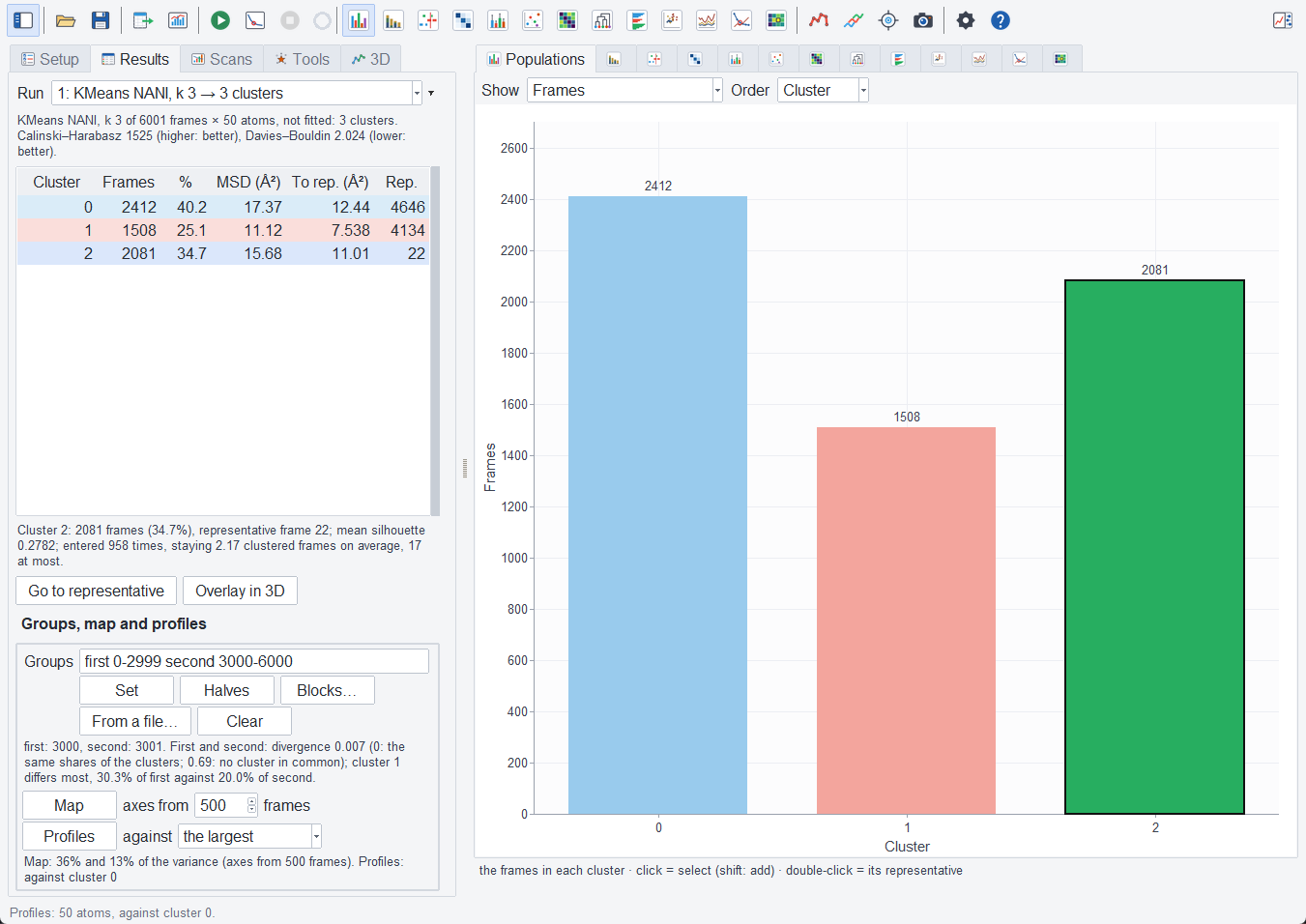
MDANCE’s tau peptide (6001 frames; resid 3 to 12 and name CA N C O H), by KMeans NANI at k 3. The trajectory’s two halves are the groups.
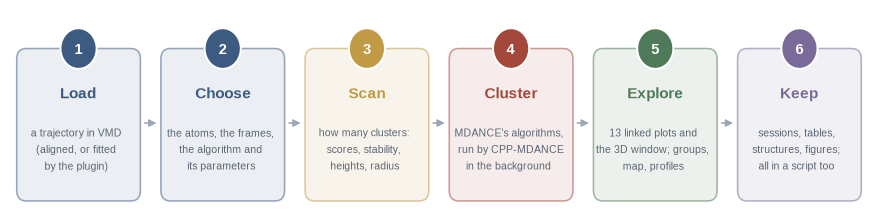
Cluster |
A molecule’s frames (all, a range, every n-th), by the coordinates of the same atoms. With KMeans NANI, DIVINE, HELM (from a first NANI clustering or a label file) or eQual (clusters within a radius, and noise). Optionally fitted to the first frame, without moving VMD’s coordinates. A warning when the frames do not look superposed. |
Choose k |
An elbow scan of the Calinski–Harabasz and Davies–Bouldin scores, ringed where they point. Davies–Bouldin’s lowest value and sharpest dip are MDANCE’s two criteria. The scan also gives the variance the clusters explain, and their stability across seedings. HELM’s merges’ heights. eQual’s scan by radius, with the radii suggested from the frames. A sweep over algorithms, k, metrics and seedings. A double-click on a value of the elbow scan or the sweep makes it the clustering. |
Explore |
The populations, the timeline of the clusters and their shares along the trajectory, their transitions and residence times. How tight and how far apart they are, the tree that joins them, every frame’s silhouette (two kinds). A cluster has one hue everywhere, in the plots and in VMD’s 3D window. Distances in Ų or Å, frames or time. |
Compare groups |
Give each frame the half, replica, condition or method it came from. See each cluster’s make-up by group, and how unlike the groups are. See a map of the frames on two principal components, and each group’s and cluster’s profile along the chain. |
Ask |
PRIME’s native-like frame, MDANCE’s extended similarity (iSIM), frames picked without clustering (the most diverse, the outliers …). |
Keep and share it |
Every clustering is kept as a run. Sessions, the MDANCE plugin’s too. Tables with a header that says how they were made. The representatives’ structures and each cluster’s trajectory. Figures at the size and text size of a paper’s column or a slide. |
Script it |
One |
Where to start
New to the plugin: Install, Quick start, then A complete analysis, a whole analysis read step by step.
How many clusters: How many clusters? Scans.
Replicas, conditions, methods: Comparing groups of frames.
The window, pane by pane: The window. Every plot: The plots.
Scripts: The command and Recipes.
Files: Files.
Citing: Citing.